
What problem does the Kelly Criterion solve?
Most decision dilemmas come down to two questions: whether to do something, and how big to do it. The former is about direction; the latter is about sizing. The Kelly Criterion focuses on the latter.
In 1956, John L. Kelly Jr. of Bell Labs derived a mathematical framework while studying noise in information transmission. He discovered that if you treat signal transmission as analogous to gambling, there is an optimal stake size that maximizes the geometric growth rate of long-term wealth.1
The discovery was later introduced to the casino and Wall Street by Edward Thorp. In Beat the Dealer, published in 1962, Thorp showed that managing bet sizes in blackjack with the Kelly Criterion provides a mathematically stable edge. Since then, the Kelly Criterion has become a foundational tool in quantitative investing and money management.2
What does the formula look like
The standard form of the Kelly Criterion:
f* = (bp - q) / b
where:
- f* — the fraction of total capital to bet each time
- p — probability of winning
- q — probability of losing (q = 1 - p)
- b — the odds (net profit on a win relative to the amount wagered)

Here’s a concrete example: suppose you’re in a game where a coin toss decides the outcome. You judge the probability of heads at 55% (p = 0.55), and winning pays 2x return (b = 1, i.e., net gain of 1x). Plug into the formula:
f* = (1 × 0.55 - 0.45) / 1 = 0.10
This means you should stake 10% of your total capital each time. Betting more won’t make you grow faster—in fact, the added volatility lowers your long-term growth rate. Betting less wastes your edge.
If the probability of heads is only 45% (below 50%), the formula returns a negative value. The meaning is clear: no edge, don’t bet.
Why “optimal” rather than “maximum”
Here’s a counterintuitive key point. Suppose you have a 60% win rate and 1:1 odds. Intuition says “since I’m favored to win, I should bet a lot.” But the Kelly Criterion says to stake 20% each time.
What if you bet 40%? In the short run, you might earn more. But over the long run, because wins and losses alternate, over-concentration causes wild swings in your capital curve. A single large loss can wipe out many rounds of accumulated gains.
Mathematically, one can prove that in repeated games, the Kelly Criterion maximizes the long-term growth rate (the geometric growth rate) of capital.3
Let’s illustrate with a simplified model. Assume total capital of 10,000 yuan, stake fraction f each round, 60% win rate, 1:1 odds. After 100 rounds, the expected capital at different stake sizes compares as follows:
| Stake size | Expected capital after 100 rounds (60% win rate) |
|---|---|
| 10% (Half-Kelly) | ~18,000 yuan |
| 20% (Full Kelly) | ~22,000 yuan |
| 30% | ~19,000 yuan |
| 40% | ~12,000 yuan |
| 50% | ~4,000 yuan |
Note: beyond the Kelly fraction, capital doesn’t decline gradually—it deteriorates sharply. That’s another layer of the Kelly Criterion: it isn’t just the “earn the most” plan; it’s also a “don’t go broke” safety boundary.
Half-Kelly and conservative strategies in real investing
Theoretically the Kelly fraction is optimal, but almost nobody in real investing runs the full Kelly. There are three reasons:
First, probability estimates themselves contain error. You think your win rate is 60%, but the true win rate might be 55% or 52%. Small misjudgments of parameters get amplified under full Kelly.
Second, odds in the real world aren’t fixed. Stock market odds (i.e., expected returns) keep changing with market sentiment, macroeconomics, and industry cycles.
Third, psychological tolerance is limited. Even if mathematically optimal, a 40% drawdown is enough to push most people into panicked capitulation.
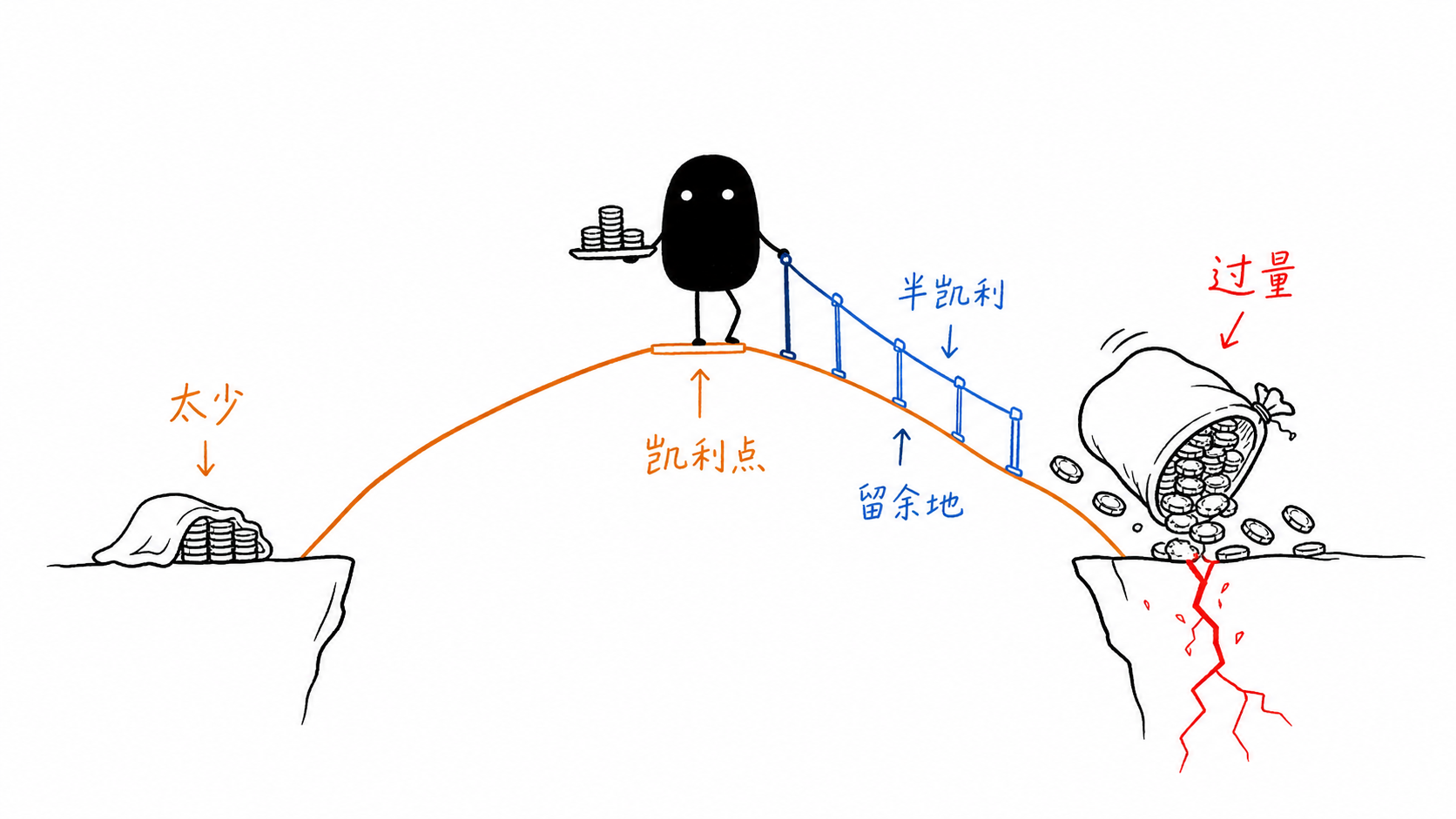
That’s why in practice most people adopt “Half-Kelly” or even lower fractions. Half-Kelly sacrifices roughly 25% of the long-term growth rate but cuts capital volatility by about 50%. This tradeoff of “a little return for a lot less volatility” is far more sustainable for most investors.4
What the Kelly Criterion teaches us about life
The core logic of the Kelly Criterion applies not only to casinos and stock markets—it offers a general decision framework.
Identify your edge. The Kelly Criterion assumes you already know p and b. In reality, the first step is to honestly assess: do I have an edge in this domain? How big is it? If the answer is “no” or “uncertain,” the formula recommends zero commitment. That in itself is a valuable life principle: concentrate resources where you have a cognitive edge.
Sizing depends on the size of the edge. The bigger the edge, the more you invest; the smaller the edge, the less. This logic applies to career choices (what are your win rate and potential returns in this track), startup decisions (how strong is your product’s differentiation against competitors), even everyday time allocation (is the marginal return on time spent on this skill declining).
Avoid “all-in” thinking. The Kelly Criterion never recommends going all-in, even with a 90% win rate. It’s a mathematical reminder about humility: the world is always uncertain, and over-concentration is the shortest path to ruin. In career planning, this means keeping your skill set diversified and your income sources spread out; in investing, it means always leaving room to maneuver.
Accept volatility and focus on the long run. The Kelly Criterion optimizes the long-term geometric growth rate, not single-period returns. This requires accepting short-term volatility as the price of admission rather than trying to win every time. Many people lose money investing precisely because they try to eliminate all volatility, and end up accumulating fees and emotional attrition through over-trading.
Common misconceptions
Myth one: The Kelly Criterion guarantees you always win. It doesn’t. The Kelly Criterion only matters when you have a genuine edge. If your win rate is below the break-even point, the formula tells you not to bet.
Myth two: As long as you compute the probabilities correctly, you can use the Kelly Criterion well. The accuracy of your probability estimates is the whole bottleneck. In reality, human probability estimates are subject to systematic biases, and overconfidence is the most common trap.
Myth three: The Kelly Criterion only applies to gambling and investing. Its underlying logic is resource-allocation optimization. Any scenario involving “how much resource should I commit to maximize long-term returns” can draw on this framework.
Summary in one sentence
The core capability the Kelly Criterion teaches us is this: in an uncertain world, translate your judgment of an edge precisely into the intensity of action—neither wasting opportunity through caution, nor destroying yourself through recklessness.
References:
- Kelly criterion - Wikipedia
- Edward O. Thorp - Wikipedia
- Kelly criterion, Wikipedia, “Practical use of Kelly criterion” section
- The Kelly Criterion - Investopedia
Author: Cyber Herald
Original URL: https://torchtree.com/en/post/kelly-criterion/
Publish Date: 2026-05-20
License: CC BY-NC-SA 4.0