On April 28, 2026, Warp’s official blog announced that its terminal client is now open source under the AGPL license, with the code hosted on GitHub. This decision is not merely a code release; it comes with a collaboration mechanism called the Agent-first Workflow, where community contributors work alongside AI Agents via Warp’s own Oz platform to drive development. OpenAI participated in the experiment as a founding sponsor.
This article analyzes Warp’s open-source motives, the impact on users, the differences between the free and paid tiers, and the product’s future direction, based on Warp’s official announcements and pricing information.
What Is Warp
Warp is a modern terminal application for developers, with core features including block-based command editing, autocompletion, history search, and AI-based Agent-assisted programming. Beyond the terminal client, Warp has also launched product lines including Agents (multi-Agent deployment and tracking), Code (building complex features in production codebases), Drive (knowledge base and context management), and Oz (cloud Agent orchestration platform).
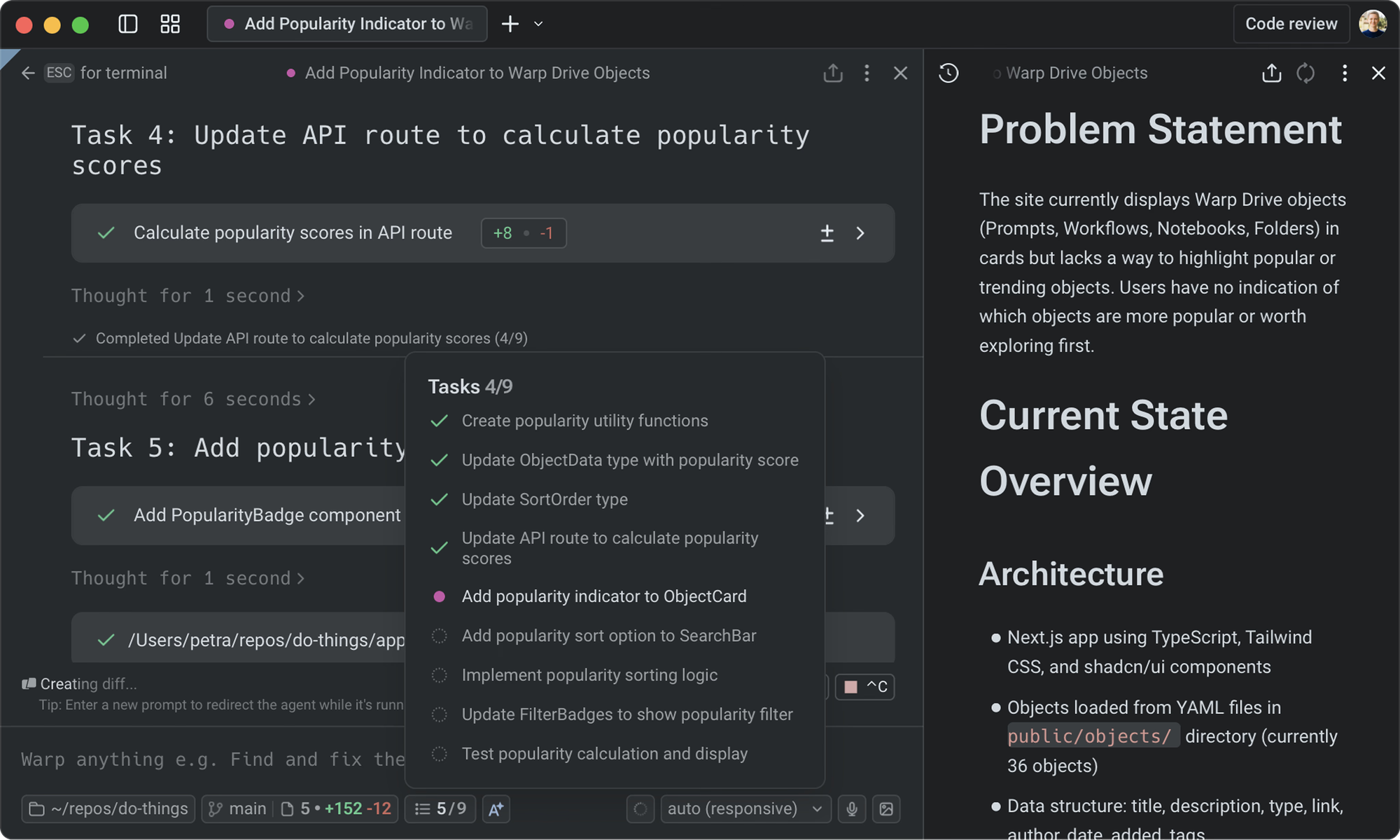
Before the open-source move, Warp’s terminal client was closed source, with AI features billed by usage. After open-sourcing, the terminal client code is public under the AGPL license, but AI capabilities and cloud services remain paid.
Why Warp Chose to Open Source Now
Warp’s official blog gives two levels of reasons.
The primary reason is a bottleneck shift in development efficiency. In traditional software development, coding itself is often the most time-consuming part. But as AI Agent capabilities improve rapidly, the Warp team found the limiting factor has shifted from “writing code” to “specification and verification done by humans.” Agents can handle the heavy lifting of implementation, while human contributors focus on higher-leverage work: deciding what to build and ensuring it’s built right. Having the open-source community participate in managing Agents could, in theory, break through the manpower ceiling of an internal team.
The secondary reason is strategic positioning in a niche. Warp points out that there is currently no fully functional open-source Agentic Development Environment (ADE) on the market. By open-sourcing its client, Warp aims to become the benchmark alternative in this emerging field, differentiating against well-funded closed-source competitors.
It’s worth noting that Warp has had open-source plans since its initial release in 2022, but only executed them in 2026. The team explains that “the rise of Agents” changed the feasibility of open-source collaboration. Without Agent assistance, the review and integration costs of large-scale community contributions would be unbearable.
What Is the Agent-first Workflow
The Agent-first Workflow is the core collaboration model Warp adopted after going open source. It works like this: community contributors propose feature directions or submit requests, Warp’s Oz platform dispatches AI Agents to do the coding, planning, testing, and other implementation work, while the core team handles final quality control and merge decisions.
The difference from traditional open-source projects: in the traditional model, community PRs require manual review and testing by the core team, making manpower the bottleneck; in the Agent-first model, Agents take on most of the implementation and verification work, and the human contributor’s role shifts from “writing code” to “setting direction” and “doing verification.”
Warp uses public GitHub issues as the single source of truth for feature tracking and has published a public roadmap for the ADE. This means the community can directly influence product direction by filing issues and joining discussions.
What Open Source Brings to Users
Transparency and Auditability
The terminal is the developer’s core entry point for interacting with the system, and the commands and data it handles often involve sensitive information. Open source means users can directly audit what Warp executes locally and how data flows. This has real value in security and compliance scenarios, especially for enterprise environments that need to vet third-party tools.
Greater Customizability
Warp has also introduced a programmable settings file, supporting configuration portability across devices. Users can adjust the interface level to their preferences, from a minimal terminal to a full ADE interface with diff views and file trees.
More Model Choice
The open-source version adds support for open-source models such as Kimi, MiniMax, and Qwen, and introduces an “auto (open)” routing feature that automatically selects the best model based on task type, reducing the cost of manual switching.
Free vs. Paid: What’s the Difference
Warp’s business model is a hybrid of “open-source client + paid cloud services.” Core terminal features are free for all users, while AI capabilities and cloud resources are tiered and billed by usage.
| Dimension | Free | Build ($18/month) |
|---|---|---|
| Core terminal features | Fully free | Fully free |
| Source code | Open source under AGPL; viewable/modifiable | Same open-source codebase |
| Monthly AI Credits | 150 (first 2 months), then 60 | 1,500 |
| Available AI models | Limited | Frontier models from OpenAI, Anthropic, Google |
| Concurrent cloud Agents | 4 | 20 |
| Cloud Agent compute | 2 vCPU / 4 GiB | 4 vCPU / 8 GiB |
| Codebase indexing | 3 codebases, 3,000 files each | 40 codebases, 100,000 files each |
| Warp Drive knowledge base | 10 workflows + 3 notebooks | Unlimited |
| BYOK (bring your own API key) | Not supported | Supported |
For pure terminal users, open source doesn’t change the experience. Warp’s block editing, autocomplete, history search, and other features remain free. The barrier to AI features is credits and model access.
In late 2025, Warp simplified its pricing from multiple tiers (Pro/Turbo/Lightspeed) into a single Build plan and introduced a Reload Credits mechanism: excess usage can be purchased at 50% less than the old pricing, valid for 12 months.
One option favorable to heavy users is BYOK (Bring Your Own Key): Build and above users can connect their own OpenAI, Anthropic, or Google API keys, so AI costs go directly onto their existing provider bills, with Warp charging only the $18/month base subscription. For developers who already have AI subscriptions, this can significantly cut total costs.
How Different Users Should Choose
| User Type | Recommended Option | Expected Cost |
|---|---|---|
| Pure terminal users | Free tier | $0 |
| Light AI users | Free tier credits | $0 |
| Developers with existing AI API keys | Build + BYOK | $18/month |
| Teams needing collaboration | Business ($45/person/month) | Per-seat pricing |
| Enterprises with strict data sovereignty | Enterprise (custom) | Custom pricing |
The free tier’s 60 credits per month is quite tight for any substantive AI-assisted development. This means most users who want Warp’s AI features will eventually need to go the paid or BYOK route.
Warp vs. Closed-Source Competitors
Warp’s open-source strategy sets it apart from closed-source competitors like Cursor and GitHub Copilot.
| Dimension | Warp | Cursor / Copilot |
|---|---|---|
| Client code | Open source under AGPL | Closed source |
| Core revenue | Cloud Agent services + AI credits | Subscription fees |
| Model choice | Multiple providers, including open-source models | Mostly proprietary/partner models |
| Community involvement | Agent-first; community sets direction | Officially driven |
| Self-hosting options | Supported in Enterprise | Generally not supported |
The strong copyleft nature of the AGPL license means any derivative work based on Warp’s code must also be open source. This may make some enterprises hesitate to deeply customize, but it also ensures community contributions flow back into the main project.
The Product’s Future Direction
Short Term: Competing on Iteration Speed
If the Agent-first collaboration model works, Warp’s feature iteration speed could significantly outpace closed-source competitors that depend on in-house engineers. Community contributors propose directions, Agents do the implementation, and the core team handles quality control. In theory, this pipeline can process a large number of feature requests in parallel.
Medium Term: Contesting the Open-Source ADE Niche
Warp explicitly positions itself as a pioneer of the “open-source Agentic Development Environment.” This niche is currently empty, but competition will intensify quickly. Whether Warp can build enough community scale and contribution quality will determine whether it can hold this position.
Long Term: Cloud Services as the Profit Core
Open-sourcing the client won’t shake Warp’s business model. AI compute, cloud Agent orchestration, and enterprise-grade management (SSO, data retention controls, self-hosted Agents) are the real revenue core. This resembles GitLab’s “open-source core + paid features” path. Warp’s Enterprise plan even supports Bring Your Own LLM and self-hosted cloud Agents, targeting large organizations with strict data sovereignty requirements.
Potential Risks and Uncertainties
The Agent-first collaboration model is experimental, and its effectiveness remains to be proven. Whether community contribution quality can be effectively amplified through Agents, and whether the core team’s review bottleneck will reappear in a new form, are open questions.
Additionally, the free tier’s low credit allowance may push many users toward paid plans. Warp needs to balance free-user growth against paid conversion, avoiding the free tier becoming a “trial trap” that harms the user experience.
Summary
Warp’s open sourcing is not the traditional “giving back to the community”; it is a business model experiment built on Agent capabilities. It uses an AGPL open-source client to build trust and transparency, and the Oz platform and cloud Agent services to build its commercial moat.
For users, pure terminal features are unaffected, and the cost of AI capabilities depends on usage intensity. For the industry, this marks a potential new phase of open-source collaboration where “humans set the direction, Agents do the execution.” Whether this model endures depends on Agent quality, community activity, and Warp’s ability to balance free and paid.
References
- Warp Is Now Open-Source, Warp official blog, 2026-04-28
- Warp Pricing, Warp official pricing page
Author: Cyber Herald
Original URL: https://torchtree.com/en/post/warp-open-source-analysis/
Publish Date: 2026-04-29
License: CC BY-NC-SA 4.0