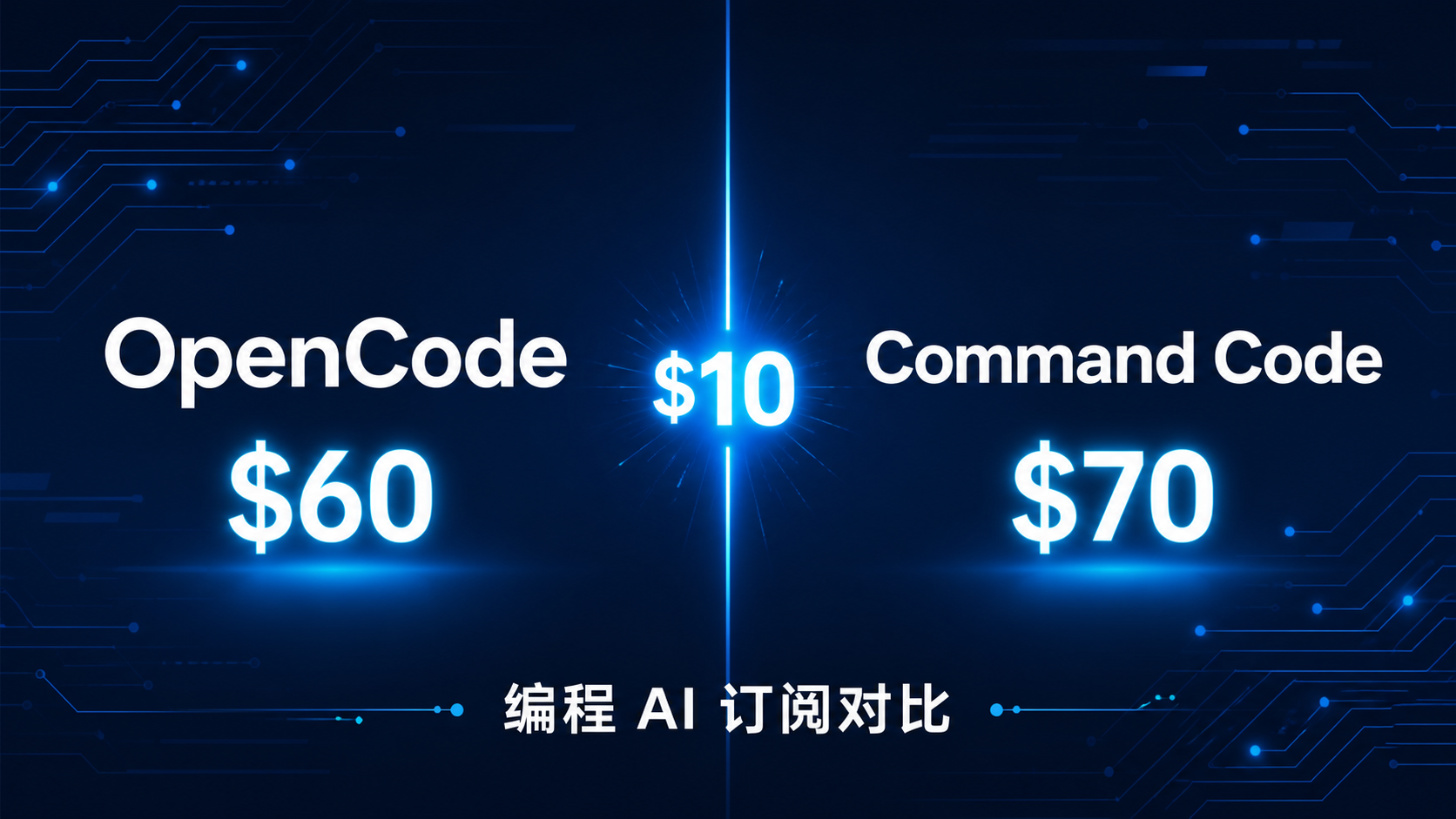
OpenCode and Command Code are both terminal-based coding agents — open-source alternatives to Claude Code. You chat with an AI in your command line and it writes code, fixes bugs, and refactors projects for you. Both let you switch between underlying models from different vendors and don’t lock you into a single provider.
OpenCode’s community is much larger, with 198K GitHub stars (measured via the GitHub API) and over 7.5 million monthly active developers. Command Code’s community is smaller — 3.7K GitHub stars (measured via the GitHub API) — but it invests more in harness engineering (the layer that optimizes tool calling for AI agents), such as a built-in Read tool that automatically filters out irrelevant file content to reduce context waste.
Both have launched low-cost subscription plans aimed at individual developers. This article compares two plans that both cost $10/month: OpenCode Go and Command Code GOAT.
Pricing and Credit Limits
Both plans use the same pricing model: you pay $10 a month and receive a credit allowance denominated in US dollars, which is consumed at each model’s actual API price. Cheaper models burn credits slowly; expensive models burn them fast.
| Dimension | OpenCode Go | Command Code GOAT |
|---|---|---|
| Monthly fee | $10 ($5 first month) | $10 |
| Monthly credit | $60 | $70 |
| Credit multiplier | 6x | 7x |
| 5-hour limit | $12 | $14 |
| Weekly limit | $30 | $35 |
| Top-ups | Yes (Zen balance) | Yes (never expires) |
The “credit multiplier” is how much model usage your $10 actually buys. OpenCode Go gives $60 (6x), while Command Code GOAT gives $70 (7x) — 17% more.
Model Library Comparison
OpenCode Go offers 19 models; Command Code GOAT offers 36+.
Shared core models include: DeepSeek V4 Pro/Flash, Kimi K3/K2.7 Code/K2.6, GLM-5.3/5.2/5.1, MiMo-V2.5/V2.5-Pro, MiniMax M3/M2.7, Qwen 3.8 Max/3.7 Max/3.7 Plus/3.6 Plus, GPT 5.6 Luna, Grok 4.5, Tencent Hy3.
These shared models are priced identically on both platforms. For example, DeepSeek V4 Pro is off-peak $0.66 input/$1.98 output per million tokens on both, and MiMo V2.5 is $0.14 input/$0.28 output per million tokens on both.
Models exclusive to Command Code GOAT include: Gemini 3.7 Flash (limited-time 50% discount), Grok 4.6, Muse Spark 1.2, Laguna S 2.1 (free, limited capacity), Inkling, Step 3.7/3.5 Flash, Qwen 3.7 Flash, and more MiniMax variants.
Exclusive Discounts
The general model pricing is the same on both platforms, but Command Code GOAT has a series of permanent or time-limited discounts:
MiMo V2.5 Pro: permanent 99% discount. It has a dedicated $30 monthly quota on GOAT, equivalent to roughly $150 of usage at the discounted rate. On OpenCode Go, this model consumes credits at standard pricing with no extra benefit.
MiMo V2.5: permanent 98% discount. Output drops from about $4.00 to $0.28 per million tokens, and input from about $0.80 to $0.14. Using this model on GOAT, a $10 subscription is equivalent to roughly $100 of standard-priced usage.
MiniMax M3: permanent 50% discount. Your credit effectively doubles.
Laguna S 2.1: completely free. This is Poolside’s open-source coding model — all tokens (input, output, cached reads) cost $0, with limited capacity on a first-come, first-served basis.
Gemini 3.7 Flash: 50% off until December 31, 2026.
OpenCode Go has no exclusive discounts; all models consume credits at standard pricing.
This means that if you frequently use MiMo or MiniMax models, Command Code GOAT’s effective capacity far exceeds the nominal $70. For heavy users of these models, GOAT’s value advantage goes well beyond 17% — the real gap can be several times.
API Access
Both platforms offer API access, but the implementations differ.
OpenCode Go’s API endpoint is https://opencode.ai/zen/go/v1/chat/completions (OpenAI-compatible format). You can call it directly with an API key, or configure it as a custom provider in other coding agents.
Command Code GOAT similarly offers API endpoints compatible with both OpenAI Chat Completions and Anthropic Messages, with a single API key used for both the CLI and external calls.
Both platforms’ APIs can plug into other toolchains. For developers who only write code in the terminal, this difference barely matters. If your workflow involves multiple tools sharing one model subscription, both work — the difference comes down to endpoint format and integration convenience.
How to Choose
Already in the Command Code ecosystem: Upgrading to GOAT is the natural choice — more credit and exclusive discounts right away.
Value model diversity: GOAT’s 36+ models nearly double OpenCode Go’s 19, and the extras include popular options like Gemini 3.7 Flash and Grok 4.6.
Frequently use the MiMo line: GOAT’s permanent discounts are the decisive advantage. MiMo V2.5 Pro at 99% off and MiMo V2.5 at 98% off mean the same money goes several times further.
Just need a standalone CLI coding tool: OpenCode Go is plenty. 19 models cover mainstream needs, and $60 of monthly credit is enough for moderate usage.
The real choice depends on which models you use most. Both platforms promise not to train on your code, both accept credit cards, and extra purchased credits never expire on either.
Pricing information comes from the official OpenCode and Command Code pricing pages (August 2026); actual prices may change — refer to official announcements for the latest.
Sources
- OpenCode Go official docs
- Command Code GOAT plan docs
- Command Code pricing and limits
- OpenCode GitHub repository
- Command Code GitHub repository
Author: Cyber Herald
Original URL: https://torchtree.com/en/post/opencode-go-vs-command-code-goat/
Publish Date: 2026-08-17
License: CC BY-NC-SA 4.0