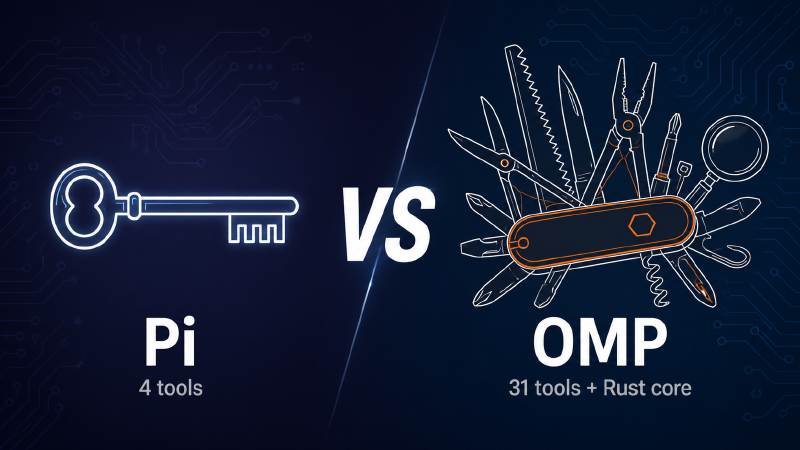
In the first half of 2026, two terminal-based coding agents sparked intense discussion in the developer community: Pi and OMP (Oh My Pi). The former is famous for minimalism, with a core of just 418 lines of code (we broke it down in detail earlier in Pi Coding Agent: A 418-Line Terminal AI Coding Agent); the latter is a feature-packed fork that rewrites roughly 80,000 lines of the underlying code in Rust.
At the heart of the discussion is a more fundamental question: is a model’s capability ceiling set by the model itself, or by the harness that wraps it?
What is Pi
Pi is a coding agent that runs in the terminal, developed by Mario Zechner. Its design philosophy can be summed up in a single line: keep only the smallest workable set of tools.
It ships with just 4 built-in tools:
- read: read files
- write: write files
- edit: edit files
- bash: run commands
There is no built-in sub-agent, no Plan Mode, and no permission confirmation flow. All extended functionality is added on demand through the plugin system.
This minimal design brings two immediate benefits. First, the initial context is small, so the model doesn’t have to load a large pile of tool descriptions when a session starts, keeping token usage low from the very beginning. Second, the core loop is short enough that a developer can read, understand, and modify the whole thing.
As of August 2026, Pi has over 84,000 stars on GitHub, supports major providers like OpenAI, Anthropic, Google, xAI, and Groq, and offers four run modes: interactive, JSON, RPC, and SDK.
What is OMP
OMP (Oh My Pi) is an official fork of Pi, developed by Can Bölük. The name pays homage to Oh My Zsh, and the positioning is similar: build a fully-featured experience on top of a lean core.
The key changes in OMP include:
31 built-in tools covering the full development loop, from file operations and code search to running tests.
A Rust core of roughly 80,000 lines, reimplementing heavy operations like ripgrep, globbing, and search as native implementations.
Support for 60+ providers, including connecting directly through an existing Claude Pro or ChatGPT Plus subscription.
LSP integration that connects directly to language servers (TypeScript, Go, Python, and more), so refactoring is based on semantic understanding rather than text matching. When you ask it to rename a function, the LSP updates every reference, barrel file, and re-export rather than doing a simple string replace.
DAP debugger support, letting you attach to running processes via dlv (Go), debugpy (Python), or lldb-dap (C/C++), set breakpoints, step through code, and inspect variable state.
A sub-agent system that splits tasks across multiple isolated worktrees and runs them in parallel, returning structured results.
Role-based routing that assigns different models to different task types: a high-reasoning model for PLAN, a fast, low-cost model for TASK, and a multimodal model for VISION.
OMP was released on December 31, 2025, and picked up more than 22,000 stars within seven months.
The Core Difference: Hashline Edits
The most notable technical difference between the two projects is how they implement file editing.
When a traditional AI agent edits a file, the model has to rewrite the entire original text so the system can “locate” the change. If a single space or tab is off, the replacement fails.
OMP introduces the Hashline Edits mechanism: when a file is read, each line gets a 2-3 character content signature. When the model edits, it just refers to the signature (for example, “replace the line with signature 2:f1”), without rewriting the whole source. If the file is modified after being read, the signature won’t match, the replacement is rejected, and the code is protected from being corrupted.
This seemingly tiny change has delivered startling results. Can Bölük tested 16 models across 180 React coding tasks (each task run 3 times), and here’s what came out:
| Model | Standard edit format | Hashline format | Improvement |
|---|---|---|---|
| Grok Code Fast 1 | 6.7% | 68.3% | 10.2x |
| MiniMax M2.1 | baseline | 2.1x | 110% |
| Claude Sonnet 4.5 | baseline | +14.4pp | — |
| Grok 4 Fast | baseline | 61% fewer tokens | — |
Across all 16 models, the average gain was about 15 percentage points.
Bölük has a summary for this: “The model is the moat, the harness is the bridge.” A model’s ceiling is set by its own ability, but whether a user can actually reach that ceiling depends on the harness design. A cheap model paired with a good edit format can beat an expensive model paired with a poor one.
Differences in Real-World Use
Initial Context and Token Usage
Pi has only 4 built-in tools, so sessions start with a small context. OMP carries 31 tools plus the capability descriptions for sub-agents, LSP, DAP, and more, so its initial context is noticeably larger.
In one two-week comparison, a developer used the same model (DeepSeek V4 Flash + Pro) on both agents and found OMP burned 1-2x more tokens than Pi. The tester built front-end features on OMP while a colleague did multi-project back-end work on Pi; by project complexity you’d expect the colleague’s usage to be higher, but the actual result was the opposite.
UI and Interaction
Pi’s interface is clean and low in information density, which suits focused work. OMP’s interface is dense, with more panels and a richer set of entry points for features. Each style has its own audience.
Permission Control
Pi has no permission confirmation flow by default, so the agent can edit files and run commands directly. OMP has a permission confirmation mechanism. For users who prefer “trust first, intervene when something goes wrong,” Pi’s design fits better.
Sub-Agent Reliability
Pi’s sub-agent has to be implemented through a third-party extension, and automatic invocation has been somewhat unstable. OMP’s sub-agent is built in, so invocation is more consistent.
Plan Mode
Pi has no built-in Plan Mode; you need to install an extension. OMP has Plan Mode built in, and it produces high-quality plans, though at a noticeably higher token cost.
A Comparison with Claude Code
Standard Compute ran a structured evaluation of OMP and Claude Code (covering 6 dimensions):
- Claude Code leads: output quality, autonomy, reliability, ease of use
- OMP leads: speed, cost-effectiveness
OMP and Claude Code take different technical routes: open source vs closed source, 60+ providers vs being locked to a single model, IDE-grade tool integration vs terminal-based capabilities.
Which One Should You Choose
Pi fits when you: prefer a minimal interface; are willing to spend time assembling an extension stack (see our practical setup guide and advanced configuration guide); care about keeping token costs down; and like a workflow where “the agent just does the work without asking.”
OMP fits when you: need LSP-level semantic refactoring; frequently reach for a debugger to chase down runtime issues; want something ready to go out of the box; or need advanced features like parallel sub-agents and cross-session memory.
Questions Worth Thinking About
In the end, the split between Pi and OMP is really two answers to the “Harness Problem.” We touched on a similar set of design trade-offs in DeepSeek Harness Open-Source Analysis, where DeepSeek’s dsh chose a third path: “everything is a plugin.”
Pi’s answer is: keep the core minimal and let users pick what they need for themselves. The cost is a longer setup time up front and third-party extensions of uneven quality.
OMP’s answer is: build in everything anyone might want, and let users disable what they don’t need. The cost is a larger initial context and a fixed token overhead in every session.
Both answers involve trade-offs. What you choose comes down to a more fundamental question: do you care more about the cost of getting started, or the ongoing cost of every session?
For developers who use coding agents heavily, the per-session token cost accumulates fast, and Pi’s minimal design is likely to be more economical over the long run. For developers who use one occasionally and want to get going quickly, OMP’s out-of-the-box experience is the more appealing option.
Sources:
- Oh My Pi: The Agent Everyone’s Talking About(YUV.AI,2026 年 8 月 6 日)
- OMP: AI Coding Agent with LSP, DAP Debugger, and Hashline Edits(Better Stack,2026 年 6 月 1 日)
- Pi vs OMP: A Coding Agent Comparison(Marga Satrya,2026 年 7 月 9 日)
- GitHub: oh-my-pi
Author: Cyber Herald
Original URL: https://torchtree.com/en/post/pi-vs-omp/
Publish Date: 2026-08-26
License: CC BY-NC-SA 4.0